On Sunday in New York City, “Six,” the pop-musical phenomenon about the not-so merry wives of Henry VIII, became the first new musical to open on Broadway, 17 months after the show’s original opening night was cancelled the same day Broadway shut down.
“I’m getting rowdy. I’m getting loud. I’m going to scream and yell and clap and be the loudest person in there,” Jimmy Fallon gushed to Variety on Oct. 3 outside the Brooks Atkinson Theatre, joined by guests including Lin-Manuel Miranda, Bowen Yang, Jeremy O. Harris, Ariana DeBose and Peppermint. “These talented people have been out of work for almost two years, and tonight I plan to party,” he hollered.
True, Sunday’s opening night was an effulgent day for the Broadway community — a full-circle event for a musical which closed five hours before Broadway collapsed and a celebration of theater-making that places 10 women on the stage in an effort to reclaim how history is told.
“Six,” a glittery pop-concert squeezed within a musical structure, pits the six wives of Henry VIII against each other in a song-battle over who suffered the most, an obvious and ironic exercise meant to question how histories of women are written in misogyny.
“We’re doing some reclamation,” Andrea Macasaet, who plays Anne Boleyn, told Variety at the opening night after-party, held at Chelsea Piers. “When 12-year- old girls see it — whether they come to the theater, listen to the album, or see it on TikTok — they see a Black woman playing a German queen, a Filipino woman playing Anne Boleyn, and they see instructions for how to create a better world.”
And that’s the other point: ‘Six’s’ opening isn’t just a gushy celebration for Broadway. It also represents an achievement for a musical arriving with a peculiar pedigree. First written by Lucy Moss and Toby Marlow as a college project, the musical released an album after premiering in the U.K. and embarked on several world tours, amassing a voracious global fandom on social media as the show landed in the West End. By the time it booked a Broadway theater, “Six” was already a global sensation.
“We’re a product of Instagram. We’re a product of TikTok, of Twitter hype. It’s food for thought when considering how shows—particularly ours, which breaks the mold for how musical theater can be defined— come to Broadway,” Jamie Armitage, “Six’s” co-director, told Variety on Sunday. “Young people may not be able to afford the ridiculous ticket prices, but they do make plenty of noise.”
“I think we need to think of our work, as actors and music theater people, as outreach,” added Brittany Mack, who plays Anne of Cleves. “All music theater is low-key non-profit, and if you think of it as a service to young people and you know how to make that entertaining, you do what ‘Six’ did. You go on tours. You build a global fandom. You make something successful,” she said at the after party.
On Broadway, “Six” is backed by producer Kevin McCollum, the veteran who brought “Rent,” “Avenue Q” and “In the Heights” to the stage and saw in “Six” the same capacity for evolution in the genre.
“Broadway was always a cultural art form — until television showed up. This show takes back the microphone,” he told Variety. “Formats like this, a musical masquerading as a pop concert, is a seminal moment for Broadway, because they’ve taken back storytelling as a form of popular entertainment. We’ll talk in 10 years and see if we’re right.”
Of course, there’s a particular irony to the show’s arriving thanks to the popularity of young fans, as Armitage noted: Most could never afford the ticket prices, a difficult reality as Broadway straddles calls for greater accessibility with the financial reality of rebuilding a theater economy.
“Yes, tickets are expensive, but when someone buys a premium ticket—an orchestra seat for a few hundred dollars—it subsidizes everyone else who can’t,” McCollum said at the afterparty, emphasizing the importance of “Six’s” digital lottery for young fans.
“If you can afford the orchestra seat, please come,” he finished. “You’ll usher in a new generation of people who are hungry for theater, kids who are savvy online or have the time to wait in line outside.”
"six" - Google News
October 06, 2021 at 04:00AM
https://ift.tt/3AhOyVw
‘Six’ Opening is Joyous as Broadway Welcomes Its First New Musical Since Shutdown - Variety
"six" - Google News
https://ift.tt/3dcBbL9
https://ift.tt/2Wis8la
It’s that time again! Today is the 28th Demo Day for Alchemist, an accelerator that primarily focuses on enterprise companies — or those that sell to other companies, primarily, rather than directly to consumers.
This latest cohort comes in at 23 companies. Like the last few Alchemist batches, this one was entirely virtual — a move that Alchemist director Ravi Belani tells me has proven to work well, noting that attendance of their virtual demo day is “up 100%” over its in-person equivalent.
I hopped on a call with Belani, who gave me a rundown of what each company is working on and shared some updates on the accelerator itself. Some of those updates:
Alchemist has raised another $4 million in funds to invest, backed by NEC, Johnson Controls and Nornickel.
The accelerator (via its AlchemistX arm) is starting to build out regional programs, working with government organizations to help them figure out how to nurture local startups. The first programs will be launched in Canada, Japan and Korea. In Canada, for example, it’s working with Innovate Edmonton on an accelerator program focused on community safety.
Alchemist companies have now raised more than $1.7 billion in funding, collectively.
Meanwhile, here are the 23 companies in the order they’re expected to present:
Codelock: An automated system that aims to prevent any unauthorized changes to your company’s application by signing and monitoring “every line of code”.
Creatify: A simplified platform for buying and selling NFTs, allowing creators to quickly put together a white-labeled NFT marketplace that plays friendly with multiple blockchains.
EngFlow: A system meant to help developers compile their code faster (5-10x faster, in their cited examples) by distributing the build process across multiple machines.
Speechki: A text-to-speech tool for creating audiobooks from synthetic voices. Allows publishers to choose from one of over 200 voices, and tweak the results (pacing, pauses, etc.) to their liking.
Moodbit: An AI-powered system that aims to detect when employees are losing interest or becoming burned out, automatically suggesting “science-based nudges” to help.
Knowron: A virtual assistant built just for industrial service workers, allowing them to say something like “Why is this machine heating up?” and have it blast through said machine’s service manuals and offer up insights on what might be wrong. Also helps to flag things like which machines cause the most issues or slowdowns.
11Sight: Browser-based video/audio call widget that can be placed on your website to quickly connect potential customers with your sales team, then track leads and integrate that data into your CRM accordingly.
The Bright App: An all in one platform for virtual personal trainers (weightlifting, yoga, dance, etc.), helping them to handle things like booking and payments. The company says they’ve already got more than 2,000 trainers onboarded.
Copyright Delta: A blockchain-based platform for verifying and managing who owns the rights to a piece of media.
Gaudium.AI: Generative AI for helping your social media team come up with new posts, generating unique copy within your specifications.
Arcturus: A “climate data analytics” tool meant to help companies identify shortcomings in their sustainability plans, or help asset managers determine how climate change and new regulation will impact their portfolio.
AltComm: An in-office tool meant to help patients with communication barriers more easily and accurately communicate with their doctors.
OnTrack Rehab: An in-home training program meant to help seniors improve their balance and reduce falls. Evaluates their progress through 15-minute exercises four times a week.
Sensory Robotics: A computer vision-based safety system for factories; using redundant 3D cameras, it watches for things like a robotic arm that’s about to collide with a human and adjusts its behavior (slowing, stopping or changing the path of the machine) accordingly.
Direktiv: It’s honestly a bit over my head, but Direktiv pitches itself as a platform-agnostic “event-driven serverless orchestration engine” in the cloud.
EMBER Medical: A telemedicine and doctor-visit booking platform built for the Middle East/North Africa. The company says it currently has over 900 doctors on the platform.
Simularge: Creates a “digital twin” of a manufacturing line to help find inefficiencies and potential cost-reductions.
Fixtender: A platform for those handling/overseeing bids on large construction projects, aiming to move the process out of e-mails/spreadsheets and into something much more contained and easily perusable.
Image Credits: Tensorfield
Tensorfield Agriculture: Autonomous weed-killer robots for agriculture, using computer vision to identify weeds in crops and precisely spray them with heated vegetable oil to kill them.
ExoVibe: a “digital ergonomics” platform that uses motion capture data to identify ergonomic risks in the workplace and, hopefully, prevent injury.
Freightify: Pitching itself as “Shopify for maritime freight”, Freightify gives freight forwarders an online store and the tools to handle it. We wrote about Freightify here.
Esper Bionics: Building a prosthetic hand that they say “improves and gains abilities over time”, with machine learning-powered signal detection that helps it grow more accurate as the user wears it.
QVALON: A cloud-based platform for retail store management, giving retail teams a place to communicate, track tasks, report issues and keep an eye on performance.
"Demo" - Google News
October 05, 2021 at 11:35PM
https://ift.tt/3AfgTf4
Here are the 23 companies pitching at Alchemist Accelerator’s Demo Day XXVIII today - TechCrunch
"Demo" - Google News
https://ift.tt/35q1UQ2
https://ift.tt/2Wis8la
Inspiration struck Toby Marlow during a comparative poetry class at Cambridge University in fall 2016. Participating in a discussion on William Blake, he found his mind wandering and began scribbling a series of unrelated notes: “Henry VIII’s wives → like a girl group … Need Lucy!!”
Then an undergraduate student tasked with writing an original show for the upcoming Edinburgh Fringe Festival, Marlow brought his idea to classmate Lucy Moss, who agreed to help bring his vision of a Tudor-themed pop musical to life. The product of the pair’s collaboration—Six, a modern reimagining of the lives of Henry VIII’s six wives—premiered on London’s West End in 2019 to much acclaim. (A cast soundtrack released in September 2018 similarly became an unqualified success.) Now, after an extended delay caused by the Covid-19 pandemic, the musical is finally making its Broadway debut.
L to R: Abby Mueller (Jane Seymour), Samantha Pauly (Katherine Howard), Adrianna Hicks (Catherine of Aragon), Andrea Macasaet (Anne Boleyn), BrittneyMack (Anna of Cleves) and Anna Uzele (Catherine Parr) Liz Lauren
Six “didn’t come out of a love of the Tudor period particularly,” says Marlow, 26. “It came from us having an interest in the representation of women in musical theater, having women on stage doing funny and hilarious things.” Moss, 27, adds, “What we were interested in doing was reframing the way that women have been perceived in history and telling their side of the story.”
The Tudor period, with its “soap opera”-esque political machinations and rich cast of female characters, offered the duo the opportunity to explore contemporary issues like feminism through a historical lens. Though Sixprominently features the rhyme historically used to describe the fates of the Tudor king’s queens—“divorced, beheaded, died, divorced, beheaded, survived”—the musical moves beyond these reductive one-word summaries to present its subjects as fully realized individuals. “With all of them,” says Moss, “there was so much of interest beyond the moment they got married or divorced.”
Marlow and Moss drew on a range of sources when writing Six, including Antonia Fraser’s The Wives of Henry VIII and documentaries hosted by historianLucy Worsley. The musical’s layered repartee deftly balances references to Tudor culture with nods to modern music, like the line “Stick around and you’ll suddenly see more” (a play on “Suddenly, Seymour” from Little Shop of Horrors). Still, Marlow explains, the show’s goal isn’t to convey history with 100 percent accuracy. Instead, “It’s [asking], ‘What if Anne Boleyn was like this?’ And how does that change the way you think about this very famous historical figure?”
Six frames its story as a makeshift talent competition in which the wife whose life was most tragic “wins.” The rules are simple: “The queen who was dealt the worst hand … shall be the one to lead the band.” Each wife sings a solo summarizing her experiences, engaging in acerbic banter in between verses. (During these numbers, the other wives act as both backup singers and dancers; beyond the six solos, the 80-minute show features three group numbers.) Ultimately, the women decide to form a girl band instead, leaving the king out of the narrative and imagining an alternate future featuring far happier ends for all of them.
Historian Jessica Storoschuk, who has writtenaboutSix extensively on her blog, has found that in school and popular culture, the queens are usually only talked about in terms of their fate. “[Six] is this kind of ridiculous satire of [that],” she says. “It’s a really intelligent way to explore their experiences, or, I should say, one part of their experiences, because their downfalls are not all of their lives.”
Below, find a song-by-song (or wife-by-wife) breakdown of the true history behind Six. Click through the interactive tools to learn more about specific lyrics from the show.
The song: “No Way,” a Beyoncé- and JLo-inspired “girl boss feminism” anthem, says Moss
Though Catherine of Aragon’s marriage to Henry lasted 24 years—collectively, his five other marriages spanned just 14 years—she has long been overshadowed by her successors. The daughter of Spanish monarchs Ferdinand and Isabella, Catherine came to England as the bride of Henry’s older brother, Arthur, Prince of Wales. But Arthur died shortly after the pair’s wedding, leading the Spanish princess to (eventually) marry his heir, Henry.
By all accounts, the couple enjoyed a loving relationship that only deteriorated due to a lack of a male heir and the king’s infatuation with Anne Boleyn. In the late 1520s, Henry sought a divorce from his first wife, arguing that her previous relationship with Arthur was the reason for the couple’s lack of a surviving son. Determined to protect her daughter Mary’s rights, Catherine refused to concede.
Apple News readers, click here to view this interactive.
Six’s account of these events, “No Way,” takes its cue from a June 21, 1529, meeting at Blackfriars in London. After years of debate over the validity of the royal couple’s marriage, a papal court was conceived to address the king’s so-called Great Matter. Appealing directly to her husband, Catherine fell to her knees and delivered an impassioned monologue:
Intending (as I perceive) to put me from you, I take God and all the world to witness, that I have been to you a true and humble wife, ever conformable to your will and pleasure. … If there be any just cause by the law that ye can allege against me, either of dishonesty or any other impediment to banish and put me from you, I am well content to depart, to my great shame and dishonor; and if there be none, then here I most lowly beseech you let me remain in my former estate, and receive justice at your princely hand.
After uttering these words, Catherine left Blackfriars, ignoring the clerk’s calls for her to return. Without turning around, she declared, “On, on, it makes no matter, for it is no impartial court for me, therefore I will not tarry.” The queen was correct in her assessment: Henry had no intention of remaining in the marriage. Determined to wed Anne, he broke from the Catholic Church in order to make her his wife.
Catherine’s Six solo could’ve been a “super emotional [sad] ballad,” says Moss. Instead, she and Marlow chose to emphasize the queen’s defiance, emulating Beyoncé’s “Run the World (Girls)” and setting the tone for the rest of the musical.
The real Catherine followed through on her fictionalized counterpart’s pledge to remain “queen till the end of my life,” refusing to acknowledge her marriage’s annulment even on her deathbed in 1536. Catherine’s legacy, historian Julia Fox told Smithsonian magazine last year, “is that of a wronged woman … who did not accept defeat, who fought for what she believed to be right until the breath left her body.”
The song: “Don’t Lose Ur Head,” a “cheeky” number modeled on Lily Allen and Kate Nash, according to Moss
Arguably the most (in)famous of the six wives, Anne is alternatively portrayed as a scheming, power-hungry seductress; a victim of her callous father’s vaulting ambition; or a worldly, charismatic woman who rose to the kingdom’s highest office only to be targeted by jealous men.
The truth of the matter depends on which scholar one asks. Most of Anne’s letters and papers were destroyed following her May 1536 execution on contrived charges of adultery, incest and conspiring to kill her husband, so much of what is known about her comes from outside observers, some of whom had reason to paint her in an unforgiving light. Even the queen’s date of birth, writes historian Antonia Fraser, is a fact “that can never be known with absolute certainty (like so much about Anne Boleyn).”
Anne’s song in Six, “Don’t Lose Ur Head,” draws its name from her method of execution: beheading by sword. Moss says she and Marlow view the number as a playful response to historians’ continued vilification of the queen as “calculating and manipulative”: “We were like, wouldn’t it be fun to mock [that trope] and make it that she was like ‘Well, I’m just living. I did this thing randomly, and now everything’s gone crazy.’”
Apple News readers, click here to view this interactive tool.
Though the tone of “Don’t Lose Ur Head” is intentionally more irreverent than the real queen, who Storoschuk says “was incredibly shrewd, very well educated, well read and well spoken,” the broad strokes of the song are historically accurate. Anne spent her teenage years in the courts of Margaret of Austria and Francis I of France, gaining a cosmopolitan worldview that helped her stand out in England. When she caught Henry’s eyes, she was a maid of honor in service of his first wife; rather than becoming Henry’s mistress, as her sister Mary had, Anne refused to sleep with the king until they were married. To wed Anne, Henry broke with the Catholic Church and established himself as head of the Church of England. Finally, the once-besotted king fell out of love in dramatic—and, for Anne, fatal—fashion just three years after their long-awaited marriage.
Henry’s third wife, Jane Seymour, has gone down in history as the “boring” one. According to Fraser, she was intelligent and “naturally sweet-natured,” with the “salient characteristics [of] virtue and common good sense.” Historian Alison Weir similarly describes Jane as “endowed with all the qualities then thought becoming in a wife: meekness, docility and quiet dignity.”
Moss and Marlow tried to flesh out these descriptions by highlighting Jane’s political savvy. During her comparatively brief courtship with Henry, Jane drew on many of the same tactics used by Anne Boleyn, most notably by refusing to sleep with him until they were married. Presenting a submissive front may have been a tactic, says Moss. It’s also worth noting that Jane used her position to advance causes she cared about, including restoring her stepdaughters, Mary and Elizabeth, to their father’s favor and speaking out against the closure of England’s religious houses.
Apple News readers, click here to view this interactive.
On one occasion, Henry reportedly dismissed his new wife by advising her to “attend to other things, [for] the last queen had died in consequence of meddling too much in state affairs.” “Heart of Stone” acknowledges this risk, but Six’s version of Jane chooses to remain steadfast in her love of Henry and their son, the future Edward VI.
Following Jane’s death in childbirth in 1537, Henry memorialized her as “the fairest, the most discreet and the most meritorious of all his wives”—a distinction no doubt motivated by the fact that she’d given the king his only surviving male heir, writes Weir. (Edward took the throne at age 9 but died just six years later, leaving the crown to his half-sister Mary.) “Six” reflects this enviable status by identifying Jane as “the only one he truly loved.” As she herself acknowledges in “Heart of Stone,” however, Henry’s affection is conditional on her ability to provide him with a son.
Henry chose to include Jane, rather than his then-wife, Catherine Parr, in this dynastic portrait. Painted around 1545, the work depicts Edward, Henry and Jane at its center and Mary and Elizabeth in the wings. Public domain via Wikimedia Commons
Speaking with Vulture last year, Moss said, “The idea was about the strength of choosing to love someone and committing to someone, and that being an equally valid feminist experience.” She added, “I love that [Jane] gets to say, ‘I wasn’t stupid, I wasn’t naïve.’”
The song: “Get Down,” a 16th-century take on the rap and hip-hop “trope of being popular and bragging about your Ferrari and your Grey Goose,” says Moss
Anne (or, as the musical calls her, Anna) of Cleves was, in some historians’ view, the most successful of Henry’s six queens. After just six months of marriage, she earned the king’s enduring affection by agreeing to an annulment. Then, she proceeded to outlive her former husband, not to mention the rest of his wives, by a decade. “[Anne] did get pushed to the side in a rather unceremonious way, but she had a pretty good life,” says Storoschuk. “She was given several properties. She gambled a lot. She got to go hunting, she had the best clothes and the best food. She was loved at court.”
A 1540s portrait of Anne of Cleves by Bartholomaeus Bruyn the Elder St. John's College, University of Oxford, via Art U.K. under CC BY-NC-ND
“Get Down” focuses on this victorious period in Anne’s life, celebrating her independence as a wealthy, unmarried woman at Tudor court. In line with the musical’s goal of reclaiming the narrative, the number also reframes the incident that led to Anne’s annulment. Henry, enchanted by a flattering Hans Holbein portrait of his bride-to-be, was reportedly repulsed by the “tall, big-boned and strong-featured” woman who arrived in England at the beginning of 1540. Declaring “I like her not! I like her not!” after their first meeting, the king only went through with the wedding to maintain diplomatic ties with Anne’s home, the German Duchy of Cleves, and other Protestant allies across the European continent.
After just six months of marriage, Henry, eager to replace his short-reigning queen with the young, vivacious Katherine Howard, had the union annulled on the grounds of non-consummation and Anne’s pre-contract with Francis, Duke of Lorraine. Anne, from then on known as the “king’s beloved sister,” spent the rest of her days in relative luxury.
Apple News readers, click here to view this interactive.
Moss studied history at Cambridge and says much of her schoolwork centered around early modern German visual culture. Six actually includes a standalone song, “Haus of Holbein,” that satirizes 16th-century beauty culture and Henry’s portrait-driven search for a fourth wife: “Hans Holbein goes around the world / Painting all of the beautiful girls / From Spain / To France / And Germany / The king chooses one / But which one will it be?”
Given Holbein’s reputation for accuracy and Henry’s own declining looks (at the time of the couple’s wedding, the king was 48 years old), Marlow and Moss chose to turn the tables, having Anne proclaim herself a fan of the much-vilified portrait. Further cementing Anne’s mastery of the situation, “Get Down”’s refrain finds the supposedly unattractive queen hanging up her likeness “for everyone to see.”
The song: “All You Wanna Do,” a catchy number modeled on the work of “young pop stars sexualized early on in their careers,” like Miley Cyrus, Britney Spears and Ariana Grande, as Marlow told Vulture
For much of history, Henry’s fifth wife, Katherine Howard, has been dismissed as a wanton woman of little import. Writing in 1991, Weir described her as a “frivolous, empty-headed young girl who cared for little else but dancing and pretty clothes.” Fraser, meanwhile, wrote that “[h]ere was no intelligent adult woman, wise in the ways of the world—and of course courts.” More recent scholarship has taken a sympathetic view of the queen, with Gareth Russell’s 2017 book, Young and Damned and Fair, leading the conversation. As Russell argues, “[Katherine] was toppled by a combination of bad luck, poor decisions and the Henrician state’s determination to punish those who failed its king.”
Katherine’s Six solo, titled “All You Wanna Do,” echoes Russell’s characterization of its subject as a victim of circumstance and predatory older men. Though her exact birthdate is unknown, Katherine may have been as young as 17 when she was beheaded on charges of treasonous adultery in February 1542. Henry, comparatively, was 50 at the time of his disgraced wife’s execution.
Apple News readers, click here to view this interactive.
The king was far from the first man to sexualize Katherine. “All You Wanna Do” details the queen’s relationships in heart-wrenching detail, from a liaison with her music teacher, Henry Manox (the song suggests that he was 23 to Katherine’s 13, but as Storoschuk points out, he may have been closer to 33), to an affair with Francis Dereham, secretary to the dowager duchess, Katherine’s step-grandmother. When each new romance begins, the teenager declares herself hopeful that this time will be different. By the end of the song, however, she realizes that all of her suitors have the same goal in mind.
According to Moss, she and Marlow wanted Katherine’s song to start out with a “sexy, seductive” tone before transforming into a “narrative of abuse” with echoes of today’s #MeToo movement. Marlow adds, “It was kind of like us talking about what happened to one of the queens and finding a way of relating it to something that we would recognize as a modern female experience.”
Katherine’s “life was so tragic,” says Storoschuk. “She was so young, and she really had very little agency over her own life. ‘All You Wanna Do’ really encompasses that.”
Often reduced to the one-word summary of “survived” or the role of nursemaid to a succession of ailing husbands, Henry’s sixth wife, Catherine Parr, was actually a renowned scholar, religious reformer and perhaps even protofeminist. In Six, she takes ownership of these attributes, refusing to be defined by her romantic relationships and instead listing her manifold accomplishments: “Remember that I was a writer / I wrote books and psalms and meditations / Fought for female education / So all my women can independently study scripture / I even got a woman to paint my picture.”
Apple News readers, click here to view this interactive.
As the last of the six to take the stage, the fictionalized Catherine has dual obligations: namely, sharing her story and setting up a satisfying musical finale. “We needed one of the queens to be like ‘Wait, we shouldn’t be competing with each other. We should support each other,’” says Moss. “Fortunately, [Catherine’s role] as a writer, educator and advocate for women helped with that.” Encouraging the wives to take back the microphone, Catherine calls for them to assert themselves outside of their marriages to Henry. “It’s not what went down in history,” the six admit, “[b]ut tonight, I’m singing this for me.”
The real Catherine led a rich life beyond what’s captured in “I Don’t Need Your Love.” As alluded to by the song’s first verses, which find Catherine telling a lover that she has “no choice” but to marry the king, the twice-married young widow initially had another suitor in mind: Thomas Seymour, the dashing younger brother of Henry’s third wife, Jane. (The would-be couple wed soon after Henry’s death in 1547, but their marriage was tainted by Thomas’ improper conduct toward his new stepdaughter, the future Elizabeth I.)
Despite being forced into a relationship with Henry, Catherine made the most of her position, pushing her husband to embrace Protestantism and encouraging him to restore his daughters to the line of succession. She narrowly escaped an attempt by the court’s conservative faction to have her executed on charges of heresy, winning back Henry’s favor even after he’d signed a warrant for her arrest. Catherine died just a year after the king, succumbing to complications from childbirth in 1548.
"six" - Google News
October 01, 2021 at 07:47PM
https://ift.tt/2ZPI3wL
The True History Behind 'Six,' the Tudor Musical About Henry VIII's Wives - Smithsonian
"six" - Google News
https://ift.tt/3dcBbL9
https://ift.tt/2Wis8la
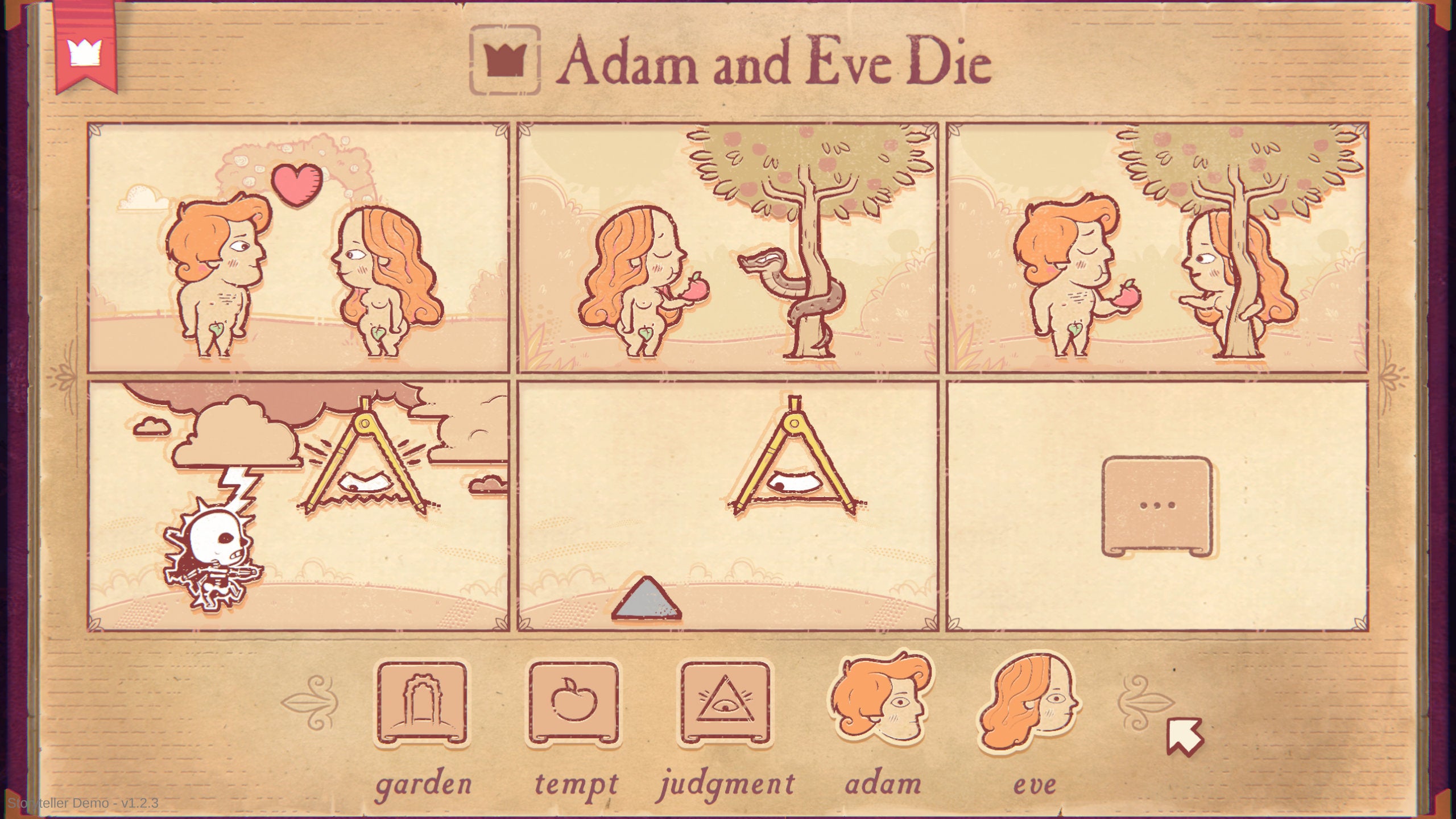
I thought Storyteller seemed promising when I first heard about the puzzle game way back in 2012, after it won the Nuovo award at the IGFs. Now that it's finally almost finished, I am delighted to play a demo in the Steam Next Fest and report back that yes, it's clever and quite delightful. Each puzzle presents you with a cast of characters, a few verbs and nouns, and an outcome which you must achieve by arranging everything in comic strip panels. Simple, clever, satisfying, and surprisingly funny.
How everything behave in panels is contextual, building on their innate character, relationships established in previous panels, and what's already happened. You know where each puzzle's story is headed but you need to figure out how to reach there, starting with a series of empty comic panels. You have to, you know, tell a story. It is fun to play with the different elements, figure out possible interactions, then eventually twig how it all comes together.
Here's an easy early example: Baron Murders Edgar. Your cast is blue-haired dandy Edgar, fair maiden Eleonora, and the dastardly Baron, and your panel backgrounds are Propose and Grave. First step is to figure out why the Baron might want to murder Edgar. Well, drag Propose into an empty panel, then pop in Edgar and Eleonora and those two will be in love. Set the next panel to Propose again, this time with Eleonora and the Baron, and the burly lad will be heartbroken that she's already in love. So cap the story off with a Grave panel, placing Edgar is in the ground and Baron standing before it, and the story logic will give him a bloody knife and a fierce scowl. You have successfully made murder happen. This gets more complicated with longer sequences, more complex stories to build, and more verbs and nouns. Finish all the puzzles and you'll unlock more complex versions of many too.
I mistakently put the already-incinerated character in the second judgment panel, so God just glared at their ashes. Very good.
Storyteller had always seemed clever, but I hadn't expected it to be funny. The little animations for actions and reactions are charming, especially when your answer isn't right and something goes wrong. Along the way, you'll accidentally create more vampires, kill the wrong person, destroy marriages, and did I mention you'll kill lots of people? The stories to solve in the demo are largely romance, fairytale, and tragedy, so there's plenty of upset.
You can download Storyteller's demo from Steam as part of the Steam Next Fest demo-o-rama. Another demo was briefly available earlier this year, but this one is updated new bits including the ability to move whole panels around, more animations, and MacOS support.
Creator Daniel Benmergui put Storyteller development on hold in 2014, explaining that after three years of work he was "starting to feel creatively numb from always dealing with the same project". He moved onto a dungeon-crawling RPG named Ernesto, which later spawned 2017's Fidel Dungeon Rescue, a cute and fun roguelikelike puzzle game about plotting a good dog's route through dangerous dungeons. Now, Storyteller again. Hooray!
The full game is due to launch... at some point? But really for real this time.
FoundersHK was created to strengthen Hong Kong’s startup community, which has weathered more than two years of political turmoil, along with the COVID-19 pandemic. Today the non-profit, which started as an events and mentoring network, held the first demo day of FoundersHK Accelerate, its equity-free accelerator program, which was created to help prepare Hong Kong startups to raise funding and scale globally.
Eleven startups (a full list is below) representing diverse sectors—pet care, fintech, insurance and education, to name a few—pitched an audience of about 500 mentors and investors. They were chosen from a pool of 150 applicants by FoundersHK’s creators, including Alfred Chuang, co-founder of BEA Systems, which was acquired by Oracle for $8.5 billion in 2008, Edith Yeung, former 500 Startups general partner and Phil Chen, founder of HTC Vive. All three are also partners in Hong Kong-based venture firm Race Capital.
One of FounderHK’s goals is to restore hope to Hong Kong’s startup ecosystem. When asked what that means to her, Yeung said, “In 2019, I landed at the airport in Hong Kong, where thousands of young people were protesting. I was overcome with sadness and even took a photo so I wouldn’t forget how I felt about the turmoil there. As a person born and raised in Hong Kong, I couldn’t just stand by and do nothing. I realized mobilizing entrepreneurship and helping founders build their startups was the best way to contribute and help, so FounderHK was born to do just that.”
One of its goals is to help Hong Kong startups secure more funding. “A lot of active investors in Hong Kong don’t invest in local Hong Kong companies. The part that is very ironic is that all unicorns in Hong Kong raised money from overseas,” Yeung said.
FoundersHK connects startups with mentors, many of whom are from Hong Kong, and work at major venture firms and tech companies like Facebook, Microsoft, LinkedIn, Apple and Grab. It held its first event in 2019, before the pandemic hit, and has since continued hosting educational events online.
One reason why FoundersHK is equity-free is because it wants to focus first on creating a culture change. “Hong Kong is a very money-driven place, so when you say that none of this will be money-driven, people are shocked,” said Chuang. “One of the things we really want to fix first is the networking issue, because people learn from other people, but they are not connected and it’s very hard to learn.”
Even though Hong Kong founders might be reluctant to talk about their challenges at first, they are eager for the opportunity, he added. “After the first person has shared what their biggest problem is, everyone else shares, because they now know they all have common problems. That brings a lot of teams together and that’s a culture changing thing.”
Chuang says that hundreds of startups have gone through FoundersHK’s mentorship program. One reason it started its accelerator program was because many teams wanted more support before approaching investors. Bonnie Cheng, a former venture partner at 500 Startups, was recruited to run FoundersHK Accelerate. The program includes weekly check-ins with FounderHK’s leaders, and a mentorship network that includes people from Sequoia Capital, Goldman Sachs, Alibaba, Monks Hill and Matrix Partners.
“We’re finding a lot of Hong Kongers from everywhere who want to help support the community and check out these companies,” said Yeung.
The past few weeks were spent prepping startups for demo day, and making sure they don’t sell themselves short in pitches, another culture change FoundersHK wants to encourage. “Fundraising is a really big part of this accelerator, really the main thing is to teach them what they need to do, what attractions do they have and how to do pitch it,” Chuang said. “A lot of our work is connecting them with investors to pitch.”
Part of FoundersHK’s work is helping startups find partners in the right markets. Since Hong Kong is a small market, most startups begin thinking about international expansion from the start, including Southeast Asia, the United States and mainland China.
More than 100 investors from those markets attended FoundersHK Accelerate’s demo day.
“To get 100 investors from around the globe in front of a bunch of Hong Kong startups, that’s never happened before,” said Chuang. “This is a first and we’re hoping this will lead into future programs. Bonnie is a mastermind and our goal is to spiral these kind of events and do more and more.”
People from FoundersHK Accelerate’s leadership team and first batch of founders
Meet FoundersHK’s first batch:
Sleekflow is a B2B sales platform created specifically for social commerce companies. Most social commerce sellers rely on WhatsApp and other messaging apps to talk to customers and close sales. Since they don’t have a centralized hub, that means social commerce sellers need to do a lot of busywork, while missing out on valuable data that can boost conversion rates. Sleekflow is a SaaS selling platform for businesses that enables them to build customer flow automation (for example, sending offers if a shopping cart has been abandoned) and analytics to keep track of sales performance. It integrates with messaging apps, social media networks and CRM software like Salesforce. Sleekflow, which works primarily with mid-market and enterprise companies, plans to expand internationally by working with channel partners.
DimOrder is a “super app for restaurant management” that says it is now used by 5% of restaurants in Hong Kong. Co-founder Ben Wong comes from a family of restaurant owners and said he wanted to create a solution to reduce the amount of labor spent on operations, while increasing profit margins. DimOrder’s frontend includes ordering, delivery with integrated logistics providers throughout Hong Kong and marketing tools. On the back end, it can handle inventory purchasing, payment and analytics. DimOrder plans to add central kitchen and school lunch box ordering for 108 schools in Hong Kong next year to its frontend, along with working capital loans, inventory management and an HR system to its back end. It will expand to Southeast Asia next year.
Spaceship is a logistics platform focused on the fragmented cross-border courier, express and parcel services market. With more than 100,000 customers so far, Spaceship lets sellers compare providers, declare shipment content, chose time slots for shipments, make payments and track packages end-to-end. It also offers consumer services like logistics booking and relocation and moving services, and will launch other verticals, including a marketplace and travel planning. Spaceship plans to expand into Taiwan before entering other markets like Singapore, Thailand and Japan.
FindRecruiter is a bounty recruiting platform to help businesses find talent much more quickly than traditional recruiting methods. Co-founder Lawton Lai was a recruiter for a decade before launching the startup, and said it typically takes about 52 days to fill an opening. FindRecruiter can reduce that to about 17 days by working with more than 500 on-demand recruiters across six Asian countries who specialize in particular fields. The platform broadcasts job openings and matches employers with recruiters based on their sector, expertise and needs. FindRecruiter says its recruiters can earn 25% more in commissions and save 30 hours on cold-calling every month. Its clients include startup unicorns and bluechip companies.
PowerArena is a deep-learning analytics platform to help monitor manufacturing operations. It currently focuses on the electronics and automotive sectors, with clients like Wistron and Jabil. Even on manufacturing floors with many automated machines, more than 72% of the work is still done by people, says PowerArena’s founders. To use PowerArena, manufacturers install 1080p cameras and connect them to the platform for real-time analytics. For example, if there is a sudden slowdown in production, PowerArena can hone in on the cause, like maintenance being performed in one part of the factory.
WadaBentohelps restaurants expand their operations and increase profit margins with automated vending machines in well-trafficked areas. It has sold 140,000 bento boxes in Hong Kong so far. Restaurants that want to expand usually have two costly options—opening new locations or delivery apps. WadaBento takes lunch boxes prepared by restaurants and puts them into their patented vending machines. Food is kept above 65 degrees during delivery and while they are in the machines, and hygiene is monitored through IoT devices. WadaBento has received patents in Japan, U.S. and China and recently signed a deal with Hong Kong’s largest fast food chain. It also recently shipped a machine to Japan, its first overseas market. It plans to deploy more than 200 machines by the first half of 2022.
Retykle wants to reduce fashion waste by making it easier to resell maternity and children’s wear. Co-founder Sarah Garner, who spent 10 years working at luxury fashion companies including LVMH, said kids on average outgrow 1,700 of clothing by the time they’re 18, but only about 5% of children’s clothing reaches the secondary market. Retykle’s goal is to keep as many items in circulation as possible. Retykle carries items for babies to mid-teens. All items are sold on consignment: sellers send clothing to Retykle, which then inspects each piece before listing it on the site. When an item sells, users get an email alert and cash or credit transfers. The company plans to launch in Singapore next month and in Australia in 2022.
Preface Coding is a tech education platform that provides scalable but customizable coding classes. Students can make on-demand bookings with teachers, and either meet with them virtually or at an offline location. The platform helps train teachers and most classes are 1:1. It serves a wide range of students, including kids aged 3 to 15, university students (especially Asian overseas students in the U.S. and Australia) and senior professionals in the financial, management and consulting industries. It’s also made partnerships with universities and banks, and plans to scale globally.
ZumVet is a pet care startup that offers video vet consultations, house visits and pharmacy deliveries, including medication and home-based diagnostic tests. Co-founder Athena Lee said ZumVet was created to help pet owners who don’t have a regular vet or live in areas where there aren’t a lot of veterinarian clinics. Vets perform consultations, create treatment plans and offer support remotely, or make house calls. Zumvet works with a network of independent vets and offers subscription plans to make pet care more affordable.
Big Bang Academy was created to address increasing demand for STEAM education and wants to make learning as “compelling as a movie, fun as a theme park and educational as a classroom” for kids. Its accredited curriculum includes videos and personalized lesson plans for each student. It also encourages a hands-on approach with experiment kits that are delivered to kids’ homes. The platform currently has 200 interactive sessions and a 70% course completion rate, a high number for an edtech platform. It business models include B2B, partnering with educational organizations, and B2C subscription models, and about 80% of its customer base is recurring. Big Bang Academy plans to diversify its content and create learning toys, too.
YAS Microinsurance is an insurtech startup with policies that can be activated in as little as five seconds, including coverage for running, biking or hiking accidents. It also recently signed its first partnership with Kowloon Motor Bus, one of the largest public bus companies in Hong Kong, to cover its passengers, including loss or theft or accidental medical expenses. YAS Microinsurance launched four months ago and says it now has $800,000 in committed revenue. About 6,300 policies were activated over the past couple of months, and it currently activates about 600 new policies per week.
"Demo" - Google News
October 05, 2021 at 11:05AM
https://ift.tt/3FsQcaX
FoundersHK, created to strengthen Hong Kong’s startup ecosystem, holds its first demo day - TechCrunch
"Demo" - Google News
https://ift.tt/35q1UQ2
https://ift.tt/2Wis8la
Square Enix released Stranger of Paradise Final Fantasy Origin’ssecond demo, showing off a little bit more of what we can expect from the action-oriented Final Fantasy spinoff. The demo gets... interesting. In one cutscene, Jack, the main character, peaced out after a boss fight in hilarious fashion. Players shared the cutscene all over social media with an air of alarmed confusion, but I am here to state for the record that if all of Stranger of Paradise is going to be like that moment, this game is going to kick so much ass.
When Stranger of Paradise Final Fantasy Originwas first announced, fans were a bit surprised since the game is being developed by Team Ninja of Dead or Alive fame. Team Ninja is also behind the Dynasty Warriors-ification of franchises like The Legend of Zelda and Fire Emblem, as well as the most controversial Metroid game. From its pedigreed developer, whatever form Stranger of Paradise was going to take, it was going to be unlike anything the franchise had ever seen — and that’s a good thing. The Final Fantasy series has been around for almost 35 years, and it’s refreshing to see Square Enix continue to try new things. Square Enix has done new and weird things with its IP (Chocobo GP anyone?), but I’d argue a spinoff action game hasn’t been seen since the likes of 2006’s Dirge of Cerberus.
That’s the vibe I get playing Stranger of Paradise — like it’s Square Enix’s attempt to relitigate the merits of Dirge of Cerberus while adding a dash of Sekiro: Shadows Die Twice for flavor. There’s a break gauge that functions almost like Sekiro’s posture gauge — depleting it makes enemies vulnerable to special finishers, but you are similarly vulnerable if your break gauge depletes. In a growing market of Soulslike games, Strangers In Paradise fits. While not being quite as hard as the famously difficult From Software games, Stranger of Paradise asks a little bit more critical thinking from its players. You cannot spam attacks like you can in Final Fantasy VII Remake and expect to walk out alive. And once you get the hang of changing combos and switching jobs, the combat is pretty cool. There’s also a relentless gloominess present in Stranger of Paradise that was in Dirge of Cerberus. But unlike Dirge, Stranger of Paradise seems to be self-aware of its edgelordiness to comedic effect. Take the gameplay clip that’s gone viral.
This rules. There is something so relatable to Jack — not Squall, not Cloud, not Lighting, but... Jack — essentially throwing up deuces and making his exit while sick tunes blare from his earbuds. In this one moment, Jack became the millennial Final Fantasy protagonist. He’s masked up, pissed off, and finds himself outnumbered and outgunned on a seemingly futile quest to defeat an oppressive and eternal evil while toothy assholes block his path. No, seriously — one way you progress through a zone is by destroying what are essentially tooth-ringed, pulsing butthole monsters.
Is this just a poorly conceived monster idea or a well-crafted meditation on the kind of people who block humanity’s progress? You be the judge. I know the conversation around Stranger of Paradise Final Fantasy Origin centers on a cutscene people might interpret as cringe, but that cringe accompanies a demo that’s weirdly compelling and a great new direction for the seminal franchise.
Stranger of Paradise Final Fantasy Origin releases on PlayStation, Xbox, and PC March 18, 2022.
"Demo" - Google News
October 05, 2021 at 05:31AM
https://ift.tt/2YhY0ec
Stranger of Paradise Final Fantasy Origin has a new demo, and it’s awesome - The Verge
"Demo" - Google News
https://ift.tt/35q1UQ2
https://ift.tt/2Wis8la



/https://tf-cmsv2-smithsonianmag-media.s3.amazonaws.com/filer_public/84/89/84897d27-6cf4-496e-a9ec-a51d096ab9c7/six_01_lizlauren.jpg)
/https://tf-cmsv2-smithsonianmag-media.s3.amazonaws.com/filer_public/9d/4a/9d4ae7a4-e8a6-41b4-bd1b-5783d080b0aa/1280px-mary_i_by_master_john.jpeg)
/https://tf-cmsv2-smithsonianmag-media.s3.amazonaws.com/filer_public/54/cc/54cce4fa-f7b8-4982-99f9-feadcb5030fe/catherine.jpg)
/https://tf-cmsv2-smithsonianmag-media.s3.amazonaws.com/filer_public/d9/d5/d9d5f44f-89f2-444b-9ebb-96dc32698564/anneboleynhever.jpeg)
/https://tf-cmsv2-smithsonianmag-media.s3.amazonaws.com/filer_public/3a/7e/3a7ee89f-19af-4037-b7d9-ba3f17c9587e/2880px-family_of_henry_viii_c_1545.jpeg)
/https://tf-cmsv2-smithsonianmag-media.s3.amazonaws.com/filer_public/61/6c/616c8d4f-40bd-4c3e-9408-b982df0afda2/ou_sjnc_pp02-001.jpg)
/https://tf-cmsv2-smithsonianmag-media.s3.amazonaws.com/filer_public/f7/f1/f7f1a2dc-3983-4346-93c4-c048316668c3/1280px-thomas_seymour_denizot.jpeg)

:format(webp):no_upscale()/cdn.vox-cdn.com/uploads/chorus_asset/file/22901108/FA4wpCgX0AQ8oJp.jpeg)