Rechercher dans ce blog

Wednesday, July 29, 2020

Demo day finally comes for 2016 flooded homeowner - WBRZ

depolitikblog.blogspot.com

BATON ROUGE - Next month will mark four years since about 140,000 homes flooded in south Louisiana. It's hard to imagine, but years after the 2016 flood, many people are still working to get their lives back together.

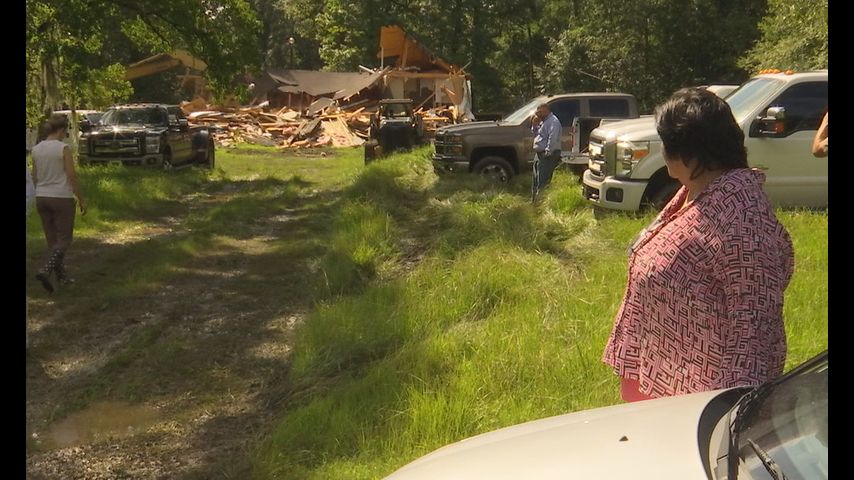
It was May 2018 when 2 On Your Side first met Alicia Donnell. Then, she was frustrated about the recovery process that seemed to have no end in sight. Wednesday, she received a bit of closure when her flood house was demolished by Restore Louisiana.

The Baton Rouge property off of South Harrells Ferry Road is about .1 miles from the Amite River. The house flooded with three feet of water on August 13, 2016. The land has been with Donnell's family since before she was born and has had its fair share of disasters. The original home caught fire in 2007 and was rebuilt in 2008.

The back and forth about what to do with Donnell's flooded house continued for months and months. It wasn't until 2018 did she learn the house was built in a floodway and she would never be able to repair it and move back in.

"I had never heard of a floodway," she said. "I had to go look it up to figure out what it meant."

A floodway is an area where water is expected to flow. In 2016, about 580 homes flooded in a designated Louisiana floodway. It was particularly challenging for Donnell, who learned that federal dollars could not be used to repair or rebuild a home in a floodway. Pat Forbes, the Executive Director of the Office of Community Development has been with Donnell throughout the process.

"It's against the law for us to put federal money into rebuilding a home in a floodway," Forbes said. "The only way we could help people like Ms. Donnell was to get them out of the floodway by buying them out."

Donnell is one of 67 homeowners that are part of the Restore Louisiana Solution 4 Buyout Program. The program helps address severe repetitive flood loss. Of those 67 award acceptances, 63 buyouts have closed and 30 of those homes have been demolished, totaling $10,118,707 in disbursements. Donnell accepted the Solution 4 servitude option, where she sold the developmental rights on her property to the Louisiana Land Trust but keeps ownership of the land as open space. Also as part of Solution 4, two neighborhoods that have experienced repetitive loss are involved in the buyout process. There are a total of 82 homes in Silverleaf in Ascension Parish and Pecan Acres in Pointe Coupee Parish that are being bought and will be demolished. The state is rebuilding homes for those residents.

Donnell thought she'd never see the day where she'd be bought out by Restore Louisiana. It's taken almost four years to get to this point.

"I had numerous people say well, just move on," she said. "I had to look at them and say, move on with what?"

Donnell says even though her home won't be where it once stood, the family property will always be something special.

"This property will always be where I grew up, no matter what happens to it will always be where I took my first step - it's just home," Donnell said.

To date, the Homeowner Assistance Program has offered over $670 million in grant funds to about 17,300 homeowners to repair or reconstruct their homes. Restore says 96 percent of the projects constructed by the program are complete and 79 percent of the homes being repaired or rebuilt by the owners are complete. It's hoping to wrap up the repairs and reconstructions by the end of the year.

"Are we glad we got $1.7 billion in federal funds to help people get out of harm's way and get their homes rebuilt, absolutely," Forbes said.

Donnell is currently searching for a new home.

Let's block ads! (Why?)


"Demo" - Google News
July 30, 2020 at 07:21AM
https://ift.tt/3jWZPnw

Demo day finally comes for 2016 flooded homeowner - WBRZ
"Demo" - Google News
https://ift.tt/35q1UQ2
https://ift.tt/2Wis8la


Six big questions about the FCC's $9B 5G fund - Light Reading

depolitikblog.blogspot.com

The FCC wants to dole out $9 billion to finance the construction of 5G networks in rural areas of the US. Naturally, the devil is in the details.

Should the agency require participants in the program to build speedy 5G networks, or are slower networks OK too? Should satellite providers be allowed to receive money from the fund? And should 4G be considered a 5G technology?

These are just some of the topics that companies across the industry are debating as the FCC considers exactly how to allocate a fund that's roughly the same size as the state of New Jersey's budget shortfall.

Here are the top 5G Fund issues under discussion:

1. How fast should the networks be?
"The Commission should set the speed target for the 5G Fund well above 35/3Mbit/s," wrote Verizon to the FCC, pointing to the agency's proposed 35Mbit/s download requirement. "The proposed 35/3Mbit/s speed target, which is within the range of current 4G LTE speeds, will have fallen far behind 5G network capabilities by the end of the support term."

Others disagreed.

"Such a requirement is not feasible in rural areas," wrote the Rural Wireless Association (RWA), a trade group that represents some of the nation's smallest wireless network operators. "As speeds increase, coverage diminishes. In order to feasibly cover rural areas, support recipients will need to be able to rely on propagation that minimizes the number of sites deployed."

Verizon's position on the topic doesn't come as much of a surprise given that it currently offers an average 5G download speed of almost 500Mbit/s, according to network-monitoring company OpenSignal. However, as the firm points out, Verizon's blazing-fast 5G network is only available in parts of a handful of cities due to the millimeter wave (mmWave) spectrum it's using. A broad buildout of 5G in mmWave spectrum in rural areas would cost far, far more than $9 billion.

Indeed, a Google study indicated it would take $400 billion to deliver 100Mbit/s to 72% of the US population using 5G in mmWave spectrum.

2. Can satellite providers get money from the 5G Fund?
"The Commission should not stifle 5G deployment by barring mobile service providers from using satellite technologies that can support latency-sensitive mobile services, such as SES's Medium Earth Orbit (MEO) satellite network," the satellite provider argued to the FCC.

Interestingly, the RWA said it would support that proposal "under certain circumstances." And the Coalition of Rural Wireless Carriers, a separate group, also entertained the notion.

But the Coalition of Rural Wireless Carriers wrote that satellite operators that want to provide 5G services with a latency threshold of 200ms would be providing services worse than 3G, considering "3G networks commonly operate at levels well below 200ms."

3. Can T-Mobile use the 5G Fund to meet its Sprint merger commitments?
Perhaps not surprisingly, virtually every company that is not T-Mobile offered a firm "no" on that question.

"The Commission should prohibit T-Mobile from using 5G Fund support to satisfy its merger commitments," AT&T wrote.

For its part, T-Mobile argued it should not be required to disclose its 5G buildout plans, and that arguments around the topic were simply efforts to "re-litigate the Sprint/T-Mobile commitments."

4. Is 4G the same as 5G?
Incredibly, this is essentially the argument that the Competitive Carriers Association (CCA) floated. "CCA continues to urge the Commission to make room in the 5G Fund for deployments like 4G LTE-A that are upgradeable to 5G," wrote the trade association, which represents some midsize wireless network operators in the US. "4G LTE-Advanced (4G LTE-A) is IP-based, as is 5G, and winning bidders should be able to deploy upgradeable radios and 4G-LTE service that can be transitioned to 5G, essentially with a software update."

In reading between the lines, some of CCA's members are likely hoping to avoid the expense of a 5G network upgrade while still getting access to the FCC's cash.

"4G LTE service (a.k.a. "5G Lite") is not true 5G, which is defined as 3GPP Release 15 or higher," stated the RWA, echoing a number of players that pushed back on the CCA's proposal.

5. Should the FCC create better broadband maps to guide the 5G Fund?
This topic probably received the most ink among the FCC's 5G Fund filings. That's no real surprise considering the agency has long faced criticism over its use of operators' service maps – widely considered inaccurate – for some of its rural broadband efforts.

Congress finally stepped into the issue with the passage of the Broadband Data Act, which essentially requires the FCC to develop new, more accurate broadband maps. The only hitch is that the legislation doesn't include the $65 million the FCC said the effort will require.

As a result, some companies urged the FCC to move ahead with parts of the 5G Fund without more accurate maps, while others argued the agency should wait until it develops better maps.

"Given that the Broadband DATA Act sets a September 2020 deadline for the Commission to adopt implementing rules, the Commission should be able to collect carriers' map data and produce the national 4G LTE coverage map in 2021, leaving more than enough time," Verizon wrote. "The benefits of accurately targeting support where it is needed far outweigh any harm from a one-year delay."

Others disagree, with one company pulling the increasingly worn COVID-19 card in its arguments.

"Accelerating the 5G Fund auction is particularly important because the COVID-19 pandemic has highlighted the critical importance of reliable broadband services to mitigate the economic toll exacted by stay at home orders," wrote satellite startup AST&Science (AST). "The goal of universal service will not be fulfilled if rural and other hard-to-serve areas are left behind in these challenging times in which the entire country is adjusting to the aftermath of this national crisis."

Of course, it comes as no surprise that AST's position on the topic directly aligns with its SpaceMobile plans for 5G from satellites.

6. Should really small carriers get special treatment?
The RWA proposed that $1.5 billion of the fund be quickly allocated to carriers with 500,000 or fewer subscribers.

Not surprisingly, that proposal was met with derision from just about every company that counts more than 500,000 subscribers.

"Doing so would not only constitute poor public policy, but would also be inefficient and run counter to the Commission's goal of maximizing the value of each dollar of universal service support," wrote T-Mobile, which has around 100 million customers.

"The Commission has consistently rebuffed proposals that would confer a competitive advantage to smaller wireless carriers and it should do so again here," added AT&T, which counts around 150 million customers.

Mike Dano, Editorial Director, 5G & Mobile Strategies, Light Reading | @mikeddano

Let's block ads! (Why?)


"six" - Google News
July 30, 2020 at 05:34AM
https://ift.tt/3089dfU

Six big questions about the FCC's $9B 5G fund - Light Reading
"six" - Google News
https://ift.tt/3dcBbL9
https://ift.tt/2Wis8la

How NASA's Demo-2 astronauts will make a historic splashdown on Earth - Space.com

depolitikblog.blogspot.com

Just over 45 years since the last American astronaut splashed down in the ocean, NASA and its partner SpaceX are set to land astronauts in the sea again on Aug. 2.

The agency announced last week that SpaceX's Demo-2 commercial crew mission, carrying NASA astronauts Doug Hurley and Bob Behnken, is set to return to Earth, splashing down in the ocean near Florida in one of seven designated landing sites. The mission is expected to land at 2:42 p.m. EDT (1842 GMT), as long as the weather and technical systems co-operate, NASA said in a statement

Coverage will be streaming on NASA Television, with the astronauts landing in one of these locations: off the coasts of Pensacola, Tampa, Tallahassee, Panama City, Cape Canaveral, Daytona  or Jacksonville, NASA said in the same statement. The return time for the astronauts will take between six and 30 hours, depending on the exact undocking and splashdown zones chosen. For now, NASA and SpaceX expect to undock Crew Dragon from the International Space Station at 7:34 p.m. EDT (2334 GMT) on Aug. 1.

Related: SpaceX's historic Demo-2 Crew Dragon astronaut test flight

The Demo-2splashdown will be a historic moment. For one thing, it will be a "back to the future" moment: the last time astronauts made an ocean landing was on July 24, 1975 to complete the Apollo-Soyuz Test Project between the United States and the Soviet Union. The Demo-2 landing will also complete the first-ever commercial crew test mission and prepare NASA for operational flights with SpaceX; the next launch is set for September with a full crew of four astronauts.

The splashdown will usher in a new era for NASA, which finally (after more than a decade of work) has one version of replacement commercial crew spacecraft ready to launch American astronauts to the International Space Station. SpaceX and another partner, Boeing, are expected to largely replace the Soyuz spacecraft NASA astronauts have been using in the years since the agency's space shuttle program stopped flights in 2011 to access the space station.

We won't know the exact location for splashdown until roughly two days before landing, NASA added in a fact sheet, and the agreed-upon area will be confirmed at 6 hours and again at 2.5 hours before undocking. If conditions are "no go" or marginal at the landing site, undocking will likely go ahead anyway. NASA and SpaceX will continue to monitor as the astronauts get closer to Earth, since weather conditions can change quickly and they would rather preserve the option of splashing down if possible. 

If conditions ultimately aren't conducive for a landing, the crew has the option to "wave off" the landing for 24 to 48 hours and remain in space aboard Crew Ddragon Endeavour before making a second attempt.

"Splashdown locations are selected using defined priorities, starting with selecting a station departure date and time with the maximum number of return opportunities in geographically diverse locations to protect for weather changes," the agency said in the fact sheet. "Teams also prioritize locations which require the shortest amount of time between undocking and splashdown based on orbital mechanics, and splashdown opportunities that occur in daylight hours."

Recovery parameters will depend on factors such as wind speed (no greater than 15 feet, or 4.5 meters, per second), an ocean wave slope of no more than seven degrees, rain, lightning (which cannot happen within 10 miles, or 16 km), the availability of the recovery helicopters that may pick up the astronauts (the helicopters will be tested prior to deployment), the vessel's pitch and roll (which should be no greater than four degrees), the visible ceiling (no less than 500 feet, or 152 meters) and overall visibility (no less than half a mile, or 0.8 km, assuming daylight operations.)

Mission milestones

Here are the main milestones to expect for the splashdown, according to NASA:

Once the Crew Dragon Endeavour separates from the space station, it will complete two tiny engine burns to safely move away from the station. Next, Endeavour will perform four longer departure burns that will set it on a path for Earth. A few hours later, assuming splashdown conditions look good, Endeavour will complete a six-minute "departure phasing burn" to put it in the correct orbit for its splashdown area.

Next, Endeavour will let go of its trunk, which holds the spacecraft's solar arrays and other equipment, to clear its heat shield for re-entry. Endeavour then will perform a "deorbit burn" and begin its plunge into Earth's atmosphere, hitting the air at a speed of 17,500 mph (28,000 km/h). A communications blackout will last for six minutes as the heat shield reaches temperatures of 3,500 degrees Fahrenheit (1,900 degrees Celsius).

Once out of the worst of re-entry, Endeavour will pop two drogue parachutes at 18,000 feet (about 5.5 km) in altitude, slowing its drop from 350 mph to 119 mph (560 km/h to 191 km/h). Three main parachutes will deploy when Endeavour is roughly 6,000 feet (1.8 km) above the ground.

Next will be splashdown. The crew will be picked up by one of two recovery ships, either the Go Searcher or the Go Navigator. Each ship will have more than 40 personnel from NASA and SpaceX on board, including personnel such as water recovery experts, medical professionals, spacecraft engineers and other folks specialized in recovery operations.

The main recovery ship will send out two smaller ships with SpaceX personnel on board. One boat will make sure the capsule isn't leaking (the NASA Mercury Liberty Bell 7 spacecraft did accidentally sink in 1961 and was only recovered in 1999.) The boat will also make sure there are no propellant vapors that can put the crew in danger. The second boat will recover the parachutes that should, at this point, be floating freely from Endeavour in the water. 

Once that's all done, the main recovery vessel will move towards Endeavour and hoist the spacecraft (with the crew still inside) onto the main deck. Behnken and Hurley will be helped by medical professionals immediately after arrival, both for routine medical checks and to exit their spacecraft. Should all go to plan, the crew should be back on the recovery ship within 45 to 60 minutes from splashdown.

After finishing their medical checks, Hurley and Behnken will be brought to shore — either by helicopter (for six of the seven recovery areas) or by recovery ship (if the crew lands near Cape Canaveral.) It will take between 10 minutes and 80 minutes to get back on dry land, after which the crew will board a NASA plane for their return to their home base in Houston. It will take them several weeks at the least to recover from being in space, which is typical of returning crews who stay in microgravity for months at a time. 

Endeavour will take a separate path, ending up in Florida for SpaceX inspection and processing. Certifying the spacecraft for operational missions will take about six weeks, after which the next mission (Crew 1)  will be authorized for launch in September.

Follow Elizabeth Howell on Twitter @howellspace. Follow us on Twitter @Spacedotcom and on Facebook

Let's block ads! (Why?)


"Demo" - Google News
July 30, 2020 at 01:46AM
https://ift.tt/30YVaZh

How NASA's Demo-2 astronauts will make a historic splashdown on Earth - Space.com
"Demo" - Google News
https://ift.tt/35q1UQ2
https://ift.tt/2Wis8la

Chancellor's Innovation Fund Supports Six Promising Projects - NC State News

depolitikblog.blogspot.com

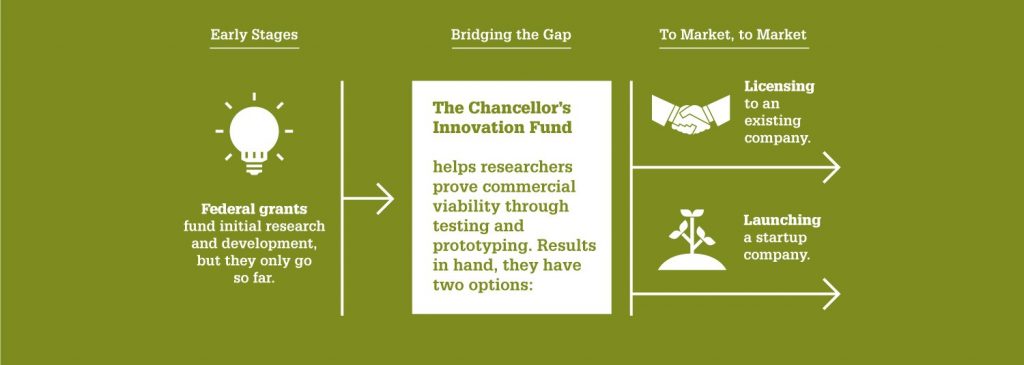
Research that starts at NC State doesn’t end here. The Chancellor’s Innovation Fund (CIF) is one way we work to ensure our research reaches the places it’s needed. 

“As a land-grant university, our mission is to positively impact the lives of the residents of North Carolina and beyond by commercializing state-of-the-art research to solve societal problems,” says Wade Fulghum, assistant vice chancellor of the Office of Research Commercialization. “The Chancellor’s Innovation Fund — which has a very successful 10-year track record, generating $18 in additional research funding or investment for every dollar awarded — plays a critical role by providing funding to translate technologies to a point where a startup can be formed for commercialization or a license can be executed with an existing company.”

The CIF, launched in 2010, provides seed funding to a select few NC State research projects each year that have promising potential for market success. The goal is to help this research bridge the critical gap between public and private funding, ultimately creating products and technology that aim to tackle today’s most pressing problems. 

To date, the CIF has granted nearly $3.4 million to 51 projects — which have attracted over $60 million in follow-on funding. These projects have generated 27 startup companies, 52 license agreements and more than $1.5 million in licensing revenue.

From safer treatments for human and animal health to novel manufacturing methods for toilet paper, lightweight car frames and synthetic fuel, read about the discoveries of this year’s CIF winners below.

RNA-based Anticoagulants 

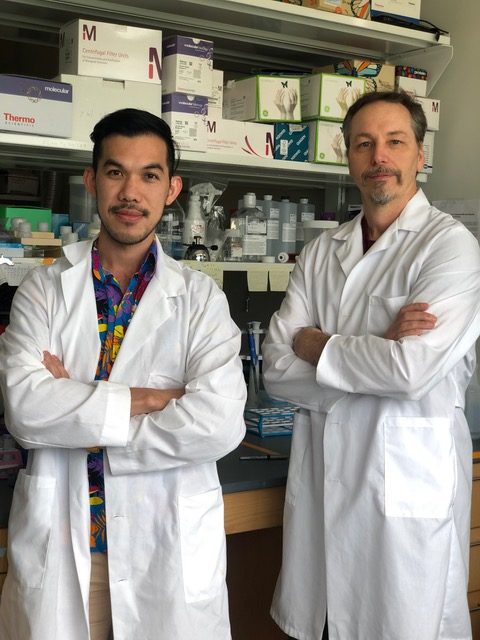
Thom LaBean and postdoc Abhichart Krissanaprasit stand in their lab wearing white lab coats.
Thom LaBean, right, and postdoc Abhichart Krissanaprasit, of the Department of Materials Science and Engineering, have created functional RNA origami structures that act as effective anticoagulants.

Most surgeries require carefully controlling bleeding and clotting — simultaneously reducing risks of blood clots and blood loss. However, the conventional anticoagulants surgeons commonly use provide a narrow treatment window, are associated with unpredictable side effects and typically lack a safe, specific antidote. 

Thom LaBean and postdoc Abhichart Krissanaprasit, of the Department of Materials Science and Engineering, have created functional RNA origami structures that act as effective anticoagulants. The RNA-based anticoagulants are more predictable and much easier to reverse — with safe, specific antidotes. The technology has the potential to reduce the risk of complications and decrease patients’ length of recovery time. 

LaBean and Krissanaprasit have founded a startup company called Helixomer to pursue commercial development of the new drug. CIF support will be used to perform FDA-required animal trials, testing efficacy and pharmacokinetics prior to human trials.

A New Form of CRISPR

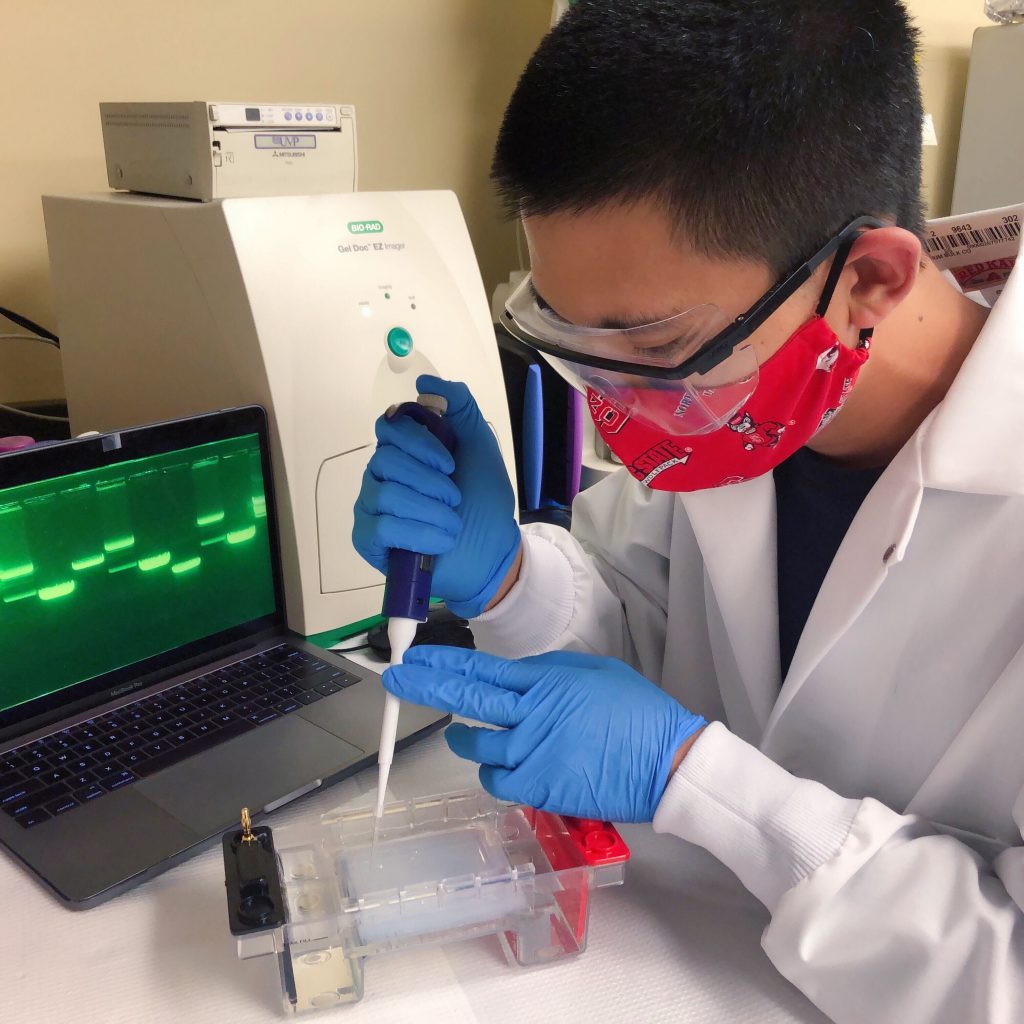
Zhongtian Zhang uses lab equipment to analyze the components of Sery-CRISPR
Zhongtian Zhang analyzes the components of Sery-CRISPR.

Most CRISPR-based gene-editing platforms fall into one of two categories: Type I, which work like a saw; or Type II, which work more like scissors and therefore are more precise but not as fast. Relatively little research has been done on Type III CRISPR platforms.

Gavin Williams, of the Department of Chemistry, along with Chase Biesel, of the Department of Chemical and Biomolecular Engineering, and graduate assistant Zhongtian Zhang have created Sery-CRISPR — a novel Type III platform that has unique applications, including rapidly editing microbial genomes to produce drugs and other therapies. 

Williams likens Sery-CRISPR to a “Swiss Army knife” because it could have cutting abilities similar to those of both Type I and Type II CRISPR platforms, and says it could be faster and easier to use compared to current technology. And as a Type III platform, Sery-CRISPR is not subject to the intellectual-property disputes surrounding Type II platforms. CIF support will be used to gain a better understanding of Sery-CRISPR and to develop its applications in gene-editing.

Plant-based Carbon Fiber

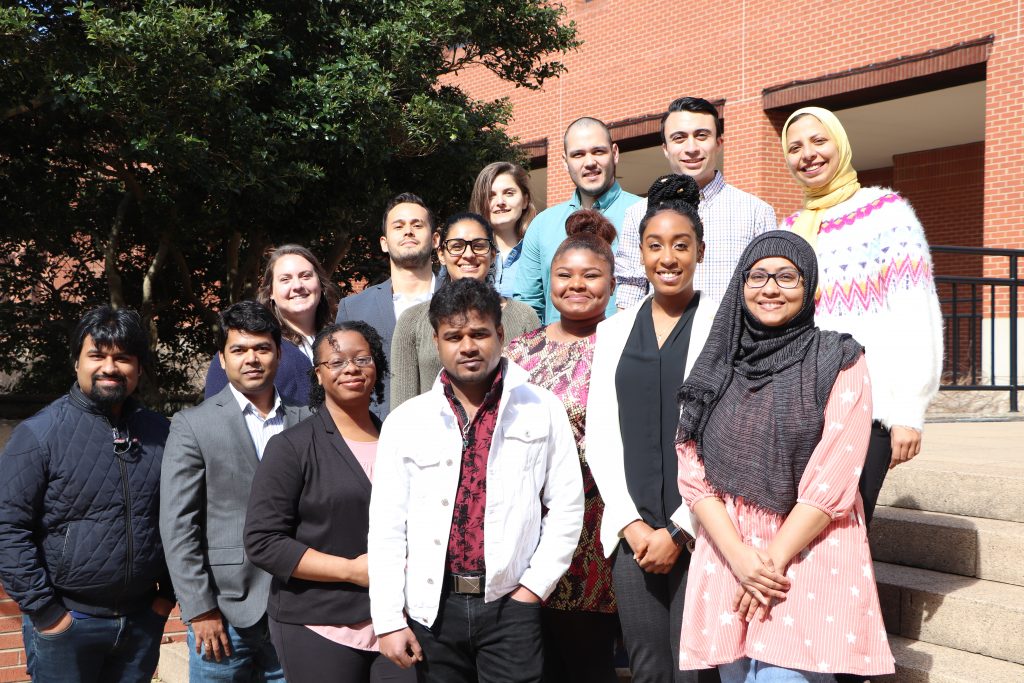
Erika Ford and students stand outside of a brick building on campus.
Ericka Ford, third from left in the front row, and graduate students from WCOT, CNR and CALS, research sustainable fiber technologies and textiles in support of agriculture and the environment.

One way to make cars more fuel-efficient is to make them lighter, which manufacturers have been getting better at for decades. And one way to make cars lighter is to reinforce their frames with carbon fiber rather than steel, but due to its high cost, carbon fiber is mostly used in luxury vehicles.

Ericka Ford, of the Department of Textile Engineering, Chemistry and Science, has developed a novel process to create carbon fiber out of lignin — the polymer in plant cell walls that gives wood its rigidity — which could make it financially feasible to use carbon fiber in mainstream-vehicle frames. The technology could also lower production costs for windmills and solar panels, among other applications. CIF support will be used to develop the lignin-based carbon fiber at a semi-production scale in order to validate that it meets industry standards, like the Oak Ridge National Laboratory’s carbonization requirements.

Synthetic Gasoline from Ethane in Shale Gas 

A person refills a car's gasoline tank.
Fanxing Li and Luke Neal, of the Department of Chemical and Biomolecular Engineering, have developed a new technology that converts distributed ethane into synthetic gasoline, which can be easily transported out of production sites.

Ethane is a major byproduct of fracked shale gas, an increasingly popular form of natural gas. Up to 20% of a typical well’s output is ethane. Due to limited transportation capacity, about 210 million barrels of ethane is flared each year. Flaring not only wastes the ethane but also creates carbon pollution. Ethane can be converted to ethylene for plastics manufacturing, but the volume of ethane each well puts out is often not worth the costs to transport it from typically remote production sites to centralized conversion plants.

Fanxing Li and Luke Neal, of the Department of Chemical and Biomolecular Engineering, have developed a new technology that converts distributed ethane into synthetic gasoline, which can be easily transported out of production sites. Their technology can fit on the bed of an 18-wheeler, and the end product is close in composition to petroleum-based gasoline. CIF support will be used to validate the ethane conversion in a large-scale microchannel reactor, as required by industry.

Sustainable Toilet Paper

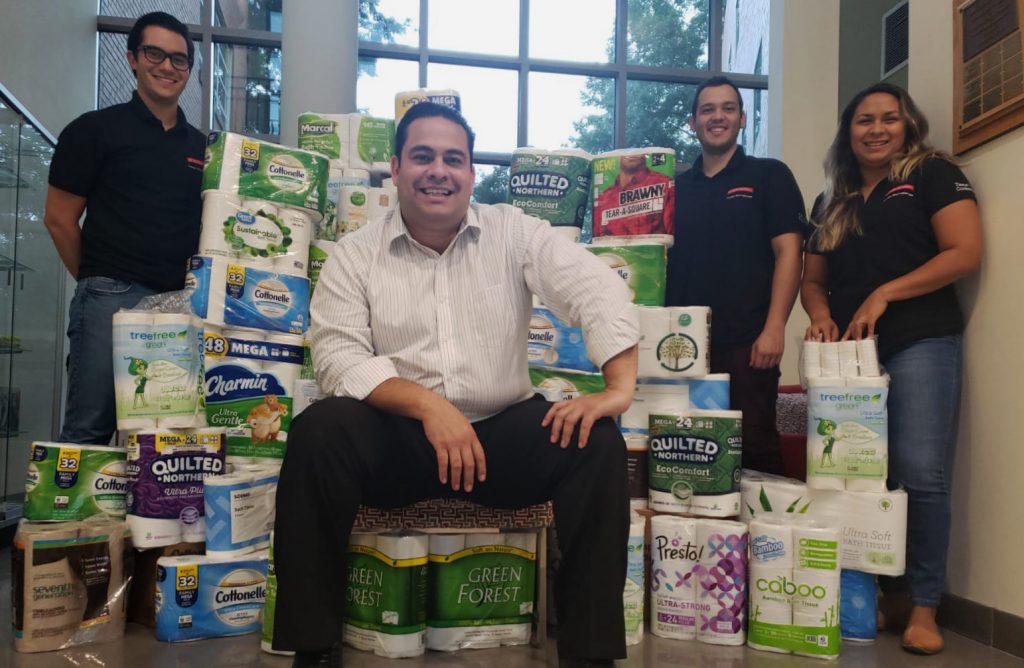
Ronalds Gonzalez sits on a make-shift chair made out of toilet paper packages while posing with three students.
Ronalds Gonzalez, center, poses with Ph.D. students Franklin Zambrano, Antonio Suarez and Amelys Brito at the “Annual Towel and Tissue Benchmarking,” hosted by the College of Natural Resources’ Tissue Pack Innovation Lab.

In the last decade, the hygiene tissue industry has struggled with higher fiber costs, a decline in the quality of recycled fibers due to digitalization, higher competition and pressures to adopt more-sustainable manufacturing methods. The cost of fibers accounts for up to 60% of total production costs.

Ronalds Gonzalez and collaborators Hasan Jameel, Lokendra Pal, Richard Venditti and doctoral student Franklin Zambrano, of the Department of Forest Biomaterials, have discovered how to make toilet paper that’s as strong and soft as today’s products while using 15% fewer fibers. Their technology, which they’ve dubbed FiRe (Fiber Reduction Technology), could lower production costs by up to 14% — potentially saving manufacturers more than $1 billion a year. 

CIF support will be used to help perform commercial-scale pilot trials. Gonzalez has strong relationships with major global hygiene tissue companies, which will allow the team to take advantage of industrial-scale facilities and equipment at no cost.

Safer Gut Supplements for Livestock

James Martin, of the Department of Chemistry, and Jonathan Holt, of the Department of Animal Science, teamed up to create CarboZn, which encapsulates a mineral form of zinc in cellulose that can be added to feed.

Zinc oxide (ZnO), once widely used to control gut health in livestock, has been banned in the European Union and is being restricted globally. ZnO can’t be properly digested, which is detrimental not only to animals but also to the environment when it leaves their system. With no effective replacement, EU swine farmers have seen a 25% increase in the mortality rate of their herds. 

So James Martin, of the Department of Chemistry, and Jonathan Holt, of the Department of Animal Science, teamed up to create CarboZn. CarboZn encapsulates a mineral form of zinc in cellulose that can be added to feed, so the right amount of Zn can be delivered to the right portion of the animal’s digestive tract — eliminating the harmful effects to animals and the environment. The technology is being tested in pigs, but it could also potentially be used in supplements for chickens, cows, horses or even humans.

CIF support will be used to perform large-scale in vivo animal trials to test CarboZn’s efficacy and yield data that can be used for market-testing. Martin and Holt have also partnered with MBA students in the Technology Entrepreneurship and Commercialization Program, who plan to help them launch a startup and commercialize the technology.

Let's block ads! (Why?)


"six" - Google News
July 29, 2020 at 10:02PM
https://ift.tt/3fcVMjb

Chancellor's Innovation Fund Supports Six Promising Projects - NC State News
"six" - Google News
https://ift.tt/3dcBbL9
https://ift.tt/2Wis8la

Six suggestions for recharging the Penguins' power play - Pittsburgh Post-Gazette

depolitikblog.blogspot.com
MENU
  • Facebook Messenger Icon

ACCOUNT

SECTIONS

OTHER

CLASSIFIEDS

CONTACT US / FAQ

Let's block ads! (Why?)


"six" - Google News
July 29, 2020 at 10:47PM
https://ift.tt/3hMDxmh

Six suggestions for recharging the Penguins' power play - Pittsburgh Post-Gazette
"six" - Google News
https://ift.tt/3dcBbL9
https://ift.tt/2Wis8la

Idaho State Fire Marshal's Investigate Six Intentional Fires Set Along US95, Number of Fires Along Highway Now at 14 Since July 23 - bigcountrynewsconnection.com

depolitikblog.blogspot.com

NAPLES, ID - On Tuesday, July 28, fire investigators from Idaho Department of Lands Fire Information and Idaho State Fire Marshal's Office responded to six additional fires that were intentionally set along Highway 95, approximately 2 miles north of Naples, ID. This now makes the number of intentional fires set along US95 this week to 14.

On Thursday, July 23 between the hours of 7:30am - 9:00am, investigators were called to investigate eight fires along US95 just South of Athol, ID. All fires have been set on the west side of the road (southbound traffic).

“We are asking the public to contact us with any information that will help solve the origin of these fires,” said Idaho State Fire Marshal Knute Sandahl. “Arson is a serious crime, and intentionally starting fires to vegetation in the hot summer is alarming—fires like these can rapidly spread, causing damage to personal property, our timber industry, or worse, injure or kill someone.”

Fire officials urge the public to report any information they might have on either string of fires along HWY 95. Information can be direct messaged to either of their Facebook pages, or by calling 1-877-75-ARSON

US95 Highway Fire 728 (1)

Photo: Idaho Department of Lands Fire Information Facebook

More from this section

Let's block ads! (Why?)


"six" - Google News
July 29, 2020 at 09:52AM
https://ift.tt/3hOXYiK

Idaho State Fire Marshal's Investigate Six Intentional Fires Set Along US95, Number of Fires Along Highway Now at 14 Since July 23 - bigcountrynewsconnection.com
"six" - Google News
https://ift.tt/3dcBbL9
https://ift.tt/2Wis8la

Six U.S. states see record COVID-19 deaths, Latinos hit hard in California - Reuters

depolitikblog.blogspot.com

(Reuters) - A half-dozen U.S. states in the South and West reported one-day records for coronavirus deaths on Tuesday and cases in Texas passed the 400,000 mark as California health officials said Latinos made up more than half its cases.

FILE PHOTO: Emergency Medical Technicians (EMT) leave with a patient at North Shore Medical Center where the coronavirus disease (COVID-19) patients are treated, in Miami, Florida, U.S. July 14, 2020. REUTERS/Maria Alejandra Cardona

Arkansas, California, Florida, Montana, Oregon and Texas each reported record spikes in fatalities.

In the United States more than 1,300 lives were lost nation wide on Tuesday, the biggest one-day increase since May, according to a Reuters tally.

California health officials said Latinos, who make up just over a third of the most populous U.S. state, account for 56% of COVID-19 infections and 46% of deaths. Cases are soaring in the Central Valley agricultural region, with its heavily Latino population, overwhelming hospitals. The state on Tuesday reported 171 deaths.

Florida saw 191 coronavirus deaths in the prior 24 hours, the state health department said.

Texas added more than 6,000 new cases on Monday, pushing its total to 401,477, according to a Reuters tally. Only three other states - California, Florida and New York - have more than 400,000 total cases. The four are the most populous U.S. states.

California and Texas both reported decreases in overall hospitalizations as Dr. Anthony Fauci, a top U.S. infectious diseases expert, saw signs the surge could be peaking in the South and West while other areas were on the cusp of new outbreaks.

Fauci said early indications showed the percentage of positive coronavirus tests rising in Ohio, Indiana, Tennessee and Kentucky.

TEACHERS’ UNION FIGHTS

The rise in U.S. deaths and infections has dampened early hopes the country was past the worst of an economic crisis that has decimated businesses and put millions of Americans out of work.

The trend has fueled a bitter debate over the reopening of schools in the coming weeks. President Donald Trump and members of his administration have pushed for students to return to class, while some teachers and local officials have called for online learning.

“We will fight on all fronts for the safety of students and their educators,” Randi Weingarten, president of the American Federation of Teachers, said during the union’s virtual convention on Tuesday. “It’s the 11th hour; we need the resources now.”

The Texas Education Agency, the state’s overseer of public education, said it would deny funding to schools that delay in-person classes because of orders by local health authorities related to the pandemic.

Texas Attorney General Ken Paxton issued guidance that health authorities cannot impose “blanket” school closures for coronavirus prevention. Any such decision is up to school officials, he said.

Local health leaders in the biggest metropolitan areas in Texas, including Houston and Dallas, have recently ordered the postponement of in-person classes.

In Washington, some Republicans in the U.S. Senate pushed back against their own party’s $1 trillion coronavirus relief proposal the day after it was unveiled by Majority Leader Mitch McConnell, weighing on U.S. stocks.

“I’m not for borrowing another trillion dollars,” Republican Senator Rand Paul told reporters.

Democrats have rejected the plan as too limited compared with their $3 trillion proposal that passed the House of Representatives in May. Some Republicans called it too expensive.

Trump said on Tuesday he did not support everything in the Senate Republican coronavirus relief legislation but would not elaborate.

“There are also things that I very much support,” he told a White House briefing. “But we’ll be negotiating.”

Trump also groused about Fauci’s high approval ratings and joked “nobody likes me” as he struggles to improve his standing with voters over his handling of the coronavirus pandemic.

Slideshow (4 Images)

“It can only be my personality,” said Trump.

(GRAPHIC: Tracking the novel coronavirus in the U.S. - here)

(GRAPHIC: Where coronavirus cases are rising in the United States - here)

Reporting by Susan Heavey, Daniel Trotta, Patricia Zengerle, David Morgan, Lisa Shumaker, Maria Caspani, Brendan O'Brien, Sharon Bernstein and Dan Whitcomb; Writing by Paul Simao and Dan Whitcomb; Editing by Leslie Adler and Christian Schmollinger

Let's block ads! (Why?)


"six" - Google News
July 28, 2020 at 11:04PM
https://ift.tt/39IEjOr

Six U.S. states see record COVID-19 deaths, Latinos hit hard in California - Reuters
"six" - Google News
https://ift.tt/3dcBbL9
https://ift.tt/2Wis8la

Search

Featured Post

Granblue Fantasy: Relink's Demo Will Make a Believer Out of You - Kotaku

depolitikblog.blogspot.com Before multiple friends of mine went out of their way to sing the praises of Granblue Fantasy: Relink to ...

Postingan Populer