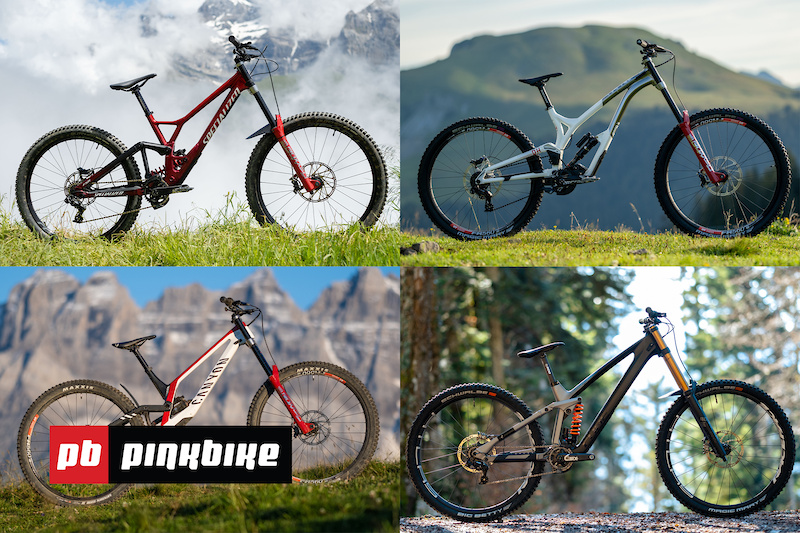
Specialized Demo Race
The Demo was the easiest to get on and ride out of the four bikes once set up. Despite being pretty far off with its recommended settings when compared to what I actually found best with the bike. Recommended was a 450lbs spring and I ended at 525lbs. It’s a bike, though, that everyone who tested said was a doddle to jump on and feel comfy enough to crack on with cranking up the speed. That was once we spent a bit of time going back and forth with shock setup to try and find a happy balance of suppleness and support without exhibiting too much chassis movement underneath you.
The Demo Race uses 148mm wide, or Boost, rear wheel with an 83mm BB, which is worth being aware of for the inevitable day that you need new wheels. If you already have a trail or enduro bike then chances are you’ll also have a 148 wide back wheel and so can make part swaps and keeping spare parts easier for your fleet.
But as we’ll go deeper into the characters of the other bikes, it doesn’t have a single track mind for speed. It doesn’t wake up in the morning with only one thing on its mind. While it can go fast, and be up there with the speeds of the other bikes, it certainly needed a bit more attention to keep it there with its window for error feeling just a tiny bit narrower than the likes of the more race focussed bikes.
The Demo Race is the only bike in the test that boasts the ability to run multiple wheel sizes. Everything from a complete 27, through mullet to full 29 setup can be achieved. But in doing so Specialized might have had to compromise the extremes of the full 29 and 27 setups to allow them to fit them in. You see there’s a big difference between the outside diameter of a 27.5” and a 29” wheel, and trying to accommodate the two into a bike and have decent geometry for each is tricky at best, even with the added adjustability that dual crown forks offer.
In the full 29” mode the Demo does gain a bit more composure at speed and if you like the feel of 29” wheels then it will start to feel a bit more similar mannered front to back. It does lengthen the rear and front of the bike though, which for the Demo puts us onto one of its bigger problems.
Our S4 test bike is the biggest that the Demo comes in and was the shortest of the four bikes tested. While its length will play a little to its easy to get on and ride character, it's a limiting factor for tall people who will likely feel too cramped on it. I’m 188cm, or 6ft 2, and I wouldn't want it any shorter.
The Demo’s easy to get on with character trait made it great fun for a variety of trails from the steep and loamy trails to the fast and manmade bike park tracks. It can turn its hand to anything and is a good companion to throw in the back of the van and take anywhere knowing that you’ll be able to ride it down anything that comes its way while having good fun.
Commencal Supreme DH 29 - 27
Like we’ve already touched on, the Commencal Supreme is one of the bikes with a single track mind. All it wants to do is go as fast as possible. Channel your inner Amaury Pierron and it does just that. Once you ride it with aggression and strength then it really rewards you with immense speed and the ability to pull up off everything in sight. It really is the butter machine for the ensuing hard flat landings.
Commencal do a great job of providing setup help for the suspension, but as we found out those settings are very much informed by the elite level racers aboard the bike. The first rides on the Supreme were difficult with the incredibly stiff springs and in particular the very fast rebound meaning that inputs to the bike were out of sync with the rider. Pushing into the bike to start to get it off the ground, or into the face of a jump had the bike springing back much sooner than desired. Slower rebound helped, but the shock's light rebound tune limited how far I could slow it down, eventually requiring a different shock to slow the rebound enough.
While this might work well for the world's best, it might not work well for many of the day-to-day average riders out there. So it’s worth experimenting with the setup if you find the suggested one a little stiff and springy.
While the high pivot philosophy is one of allowing the rear wheel to move out of the way of hits easier, it doesn’t stick its head out above the others for sole impact absorption. Single big hits, as mentioned, are dealt with really well, but repeated hits in fast succession are dealt with just as well by the other suspension systems on test.
It also has a very profound effect on the dynamic geometry of the bike and therefore the tire loading. Static our test bike had a 455mm chainstay. At sag it extended out to 475mm and by bottom out it grows to 525mm.
The bike weight is more noticeable on trail, especially going back to back with the likes of the featherweight Canyon and Cube. But it does add to the bike’s solid feel.
You can take advantage of the massive 220 rotors front and rear with the Ultra Soft compound tires. Once you ride Ultra Soft compounds you don’t really want to ride anything else, but be warned they do wear out a whole lot faster than even the next hardest compound up. But it’s nice to see Commencal spec thick DH casings and soft rubber on a bike that is meant to and wants to go fast.
As with the Specialized Demo, the mullet setup does have its advantages like trouser clearance and the potential for increased bike maneuverability. If that is what you’re after then the advantages play in your favour. But if you’ve a preference for 29” wheels then the difference in character is noticeable from front to back. While it’s not a case of night and day and something that will make a bike either rideable or not, it’s a trait in the character of the bike that should be made clear.
But even with its quirks in character, as a package the Supreme is ferociously fast and its addiction to speed is something that contagiously passes to the rider.
While the consensus is that idlers are terrible for efficiency, the reality was that on the Commencal the added drag is hardly noticeable. I know it’s a DH bike and it isn’t pedalled as much as trail or enduro bikes. But lots of riding spots need some pedalling to move around the mountain or to get to the trailhead and on the Commencal it was no more effort than on the other bikes.
Canyon Sender CFR
With little information on recommended setup, it was quite the squint eyed and speedy setup on the Canyon, which then added to the surprise come the speed on the first run down the World Cup track in Champery. I even caught myself thinking that I have no business going this speed first run on a new bike. It’s quite the addictive feeling having that much available risk taking first run and something that continued when the bike was ridden more. A lot of confidence can be placed in the Sender and makes riding challenging situations at speed just that little bit easier.
The Sender is a very easy to ride bike from the get-go and that speed in initial setup to comfortable send was something that all testers reported. In fact, personally I didn’t deviate much from the 25% sag shock setup and car park bounce to get the rebound in the right ballpark. And spent much less time going back and forth in setup to have the bike in a really good window of operation.
Like the Commencal, the character of the Sender is immediately recognisable as one that just wants to go damn fast. But differing from the Commencal is the Sender’s utmost composure in even the most challenging terrain. It seems to just deal with impacts once and be ready for the next so efficiently that it really lifts your internal thoughts from that of the bike to that of the trail in front of you. It never once got flustered despite throwing all manner of trails at it.
The sizing and geometry of the Sender feels really spot on. If asked to close my eyes and get in a position imagining I’m riding, it would likely be exactly where the Senders contact points are. For my height and intentions the size L felt comfy and a familiar space every time I jumped on it and on every trail. Yes, it’s a big race focussed bike, but it didn’t demand gritted teeth and a white knuckle grip to extract its best. A bit of that is attributable to the bike’s low weight too, making the long and slack geometry a little easier to handle.
While not the absolute supplest of suspension feels of the four bikes, that aforementioned composure is something I would much rather have than complete traction all the time. With the bikes built to do the speeds these can, traction is certainly not there at every second and so chassis control and composure come more into importance up at the ragged edge. It certainly isn’t a harsh ride, though, and does a great job of absorbing impacts of all sizes and frequencies with just a bit more feedback coming through to you.
It is however a bit confusing to have so many specific frame parts made for the different frame and wheel sizes only to use the same small links for 29” and 27.5” bikes with just two holes labeled according to the rear wheel size. Secretly they’re a progression adjuster and statically don’t alter the geometry. But it’s likely going to be a point of confusion for some owners and there will likely be some bikes run in the non-recommended setup.
The character change from the previous mullet bikes from Commencal and Specialized to this full 29er are apparent. It does demand a little more rider input to swing it over from corner to corner in quick succession. Not like trying to maneuver a barge, just a smidge more action in the piloting, but something that is rewarded in all out speed and if you like your big wheels then you’ll love the feeling on the Sender. It’s also nice to see Canyon adapt the Sender rage to accommodate the mullet configuration for smaller riders, although we have already seen Troy Brosnan on an M sized full 29” setup.
Cube TWO15 HPC SLT
And finally the Cube TWO15. A bike that still has me chin scratching a little.
It is a very fast bike, but a large slice of that is down to the geometry of the bike, with the longest on paper reach, lowest BB and slackest head angle on test. I say on paper, as when we measured the bike, the reach was actually 2mm shorter than the Canyon, at 483mm, and the head angle dipped under 63 degrees.
At the top of a run you can almost feel its urgency to go. And let it go and by God it will, but be warned that once you’ve made your bed you have to lay in it and if you change your mind on how much send you’re up for half way down, it’s too late. If you muscle it around enough then you will be an active part of the ride all the way down, but it was noticeably more tiring to ride the Cube than the other bikes, especially for some of the longer top to bottom runs.
On longer smoother more open turns it’s an easier bike to handle with a large turn in and a steady position in cornering. But not all corners are like this, and once they tighten up it needs much more body language.
Perhaps then we need to address the elephant in the room here, applicable to all these bikes - commitment levels. You probably wouldn't want to ride with the needed level of commitment that the Cube needs every run of every day. I do like to ride fast, I really do. But on the Cube, the commitment and piloting levels needed are something that I wouldn’t be in for every run of every day and do come down to some of the development choices made in the bike.
While you could say to take a size L, I do agree. The shorter reach would yield a slightly easier bike to handle. But that jump from XL to L would take it from the second biggest bike on test to the smallest, highlighting the odd size gaps that Cube went for and doesn’t get away from some of the suspension traits that the TWO15 has.
Cube opted to go for an extremely high progression level for the suspension, up at 42%. And like how a high pivot design grey's out a lot of the option boxes in development, a high progression bike does the same. The Cube’s character is that of a big bouncy sofa, with the high leverage ratios making the suspension incredibly supple but at the same time introducing a lot of chassis movement into the riding experience, that then needs to be accounted for with your natural suspension in your arms and legs. And with an already statically very low BB it does make the underside of the bike, bash guard and pedals become good friends with the ground quite often.
Upping the spring rate helps a bit to calm the chassis movement, but the character trait is still there, the simple fact is that the spring to damping balance is off due to the high leverage ratios and slow movement of the shock. That big spring needed to calm the suspension in combination with the high progression probably resulting in you using less travel than the on paper amount would suggest and me never finding the end of travel like you could on the other bikes. For example, with only considering the spring forces it needs over 600N more force to bottom it out than something like the Canyon.
The TWO15 needs some pretty solid focus to be on top of its traits. It will go fast, but the concentration and effort needed to do so are far more than the likes of the other bikes. And those traits do push the bike setup into somewhat a corner, with a slightly softer fork setup helping balance out the front to rear suspension feel and not dynamically push the rider slightly more rearwards.
"Demo" - Google News
February 22, 2021 at 10:00PM
https://ift.tt/2ZFYmZC
Review: Canyon Sender vs Specialized Demo vs Cube Two15 vs Commencal Supreme - DH Bike Week - Pinkbike.com
"Demo" - Google News
https://ift.tt/35q1UQ2
https://ift.tt/2Wis8la




No comments:
Post a Comment